Mingxuan Yan

Hi there! I am Mingxuan Yan (pron: Ming-shwen Yen), a PhD student at Georgia Institute of Technology. I am currently a member of TASL advised by Prof. Jiachen Li. Before that, I obtained my bachelor’s degree at Wuhan University of Technology, following a master’s degree at Huazhong University of Science and Technology.
My research interests lie in efficient and scalable robot learning and policy deployment.
News
| Oct 07, 2026 | Check out our new work AXIS-Bench: What Matters in Quality-Aware VLA Pretraining — A Benchmark and Empirical Study! 🎉 |
|---|---|
| Jul 23, 2026 | Check out AXIS, our work with  Axis Robotics on a growable, community-driven data engine for scalable robot manipulation. Axis Robotics on a growable, community-driven data engine for scalable robot manipulation. |
Selected Research
-
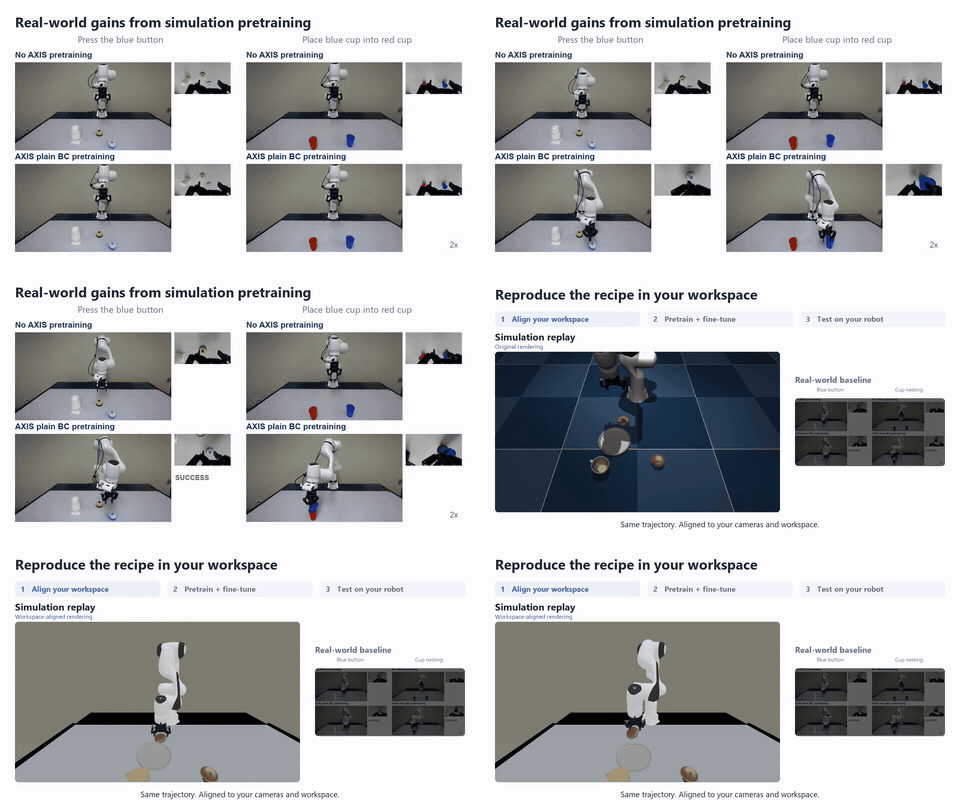
AXIS-Bench: What Matters in Quality-Aware VLA Pretraining
Under review, 2026
A controlled benchmark reveals how demonstration quality shapes VLA pretraining.
We compare weighting, filtering, and conditioning on shared demonstrations with matched training budgets. Across three VLAs, episode-level conditioning improves mean task success, while the best label granularity depends on the method and model. Replayable demonstrations also support real-world validation.
-
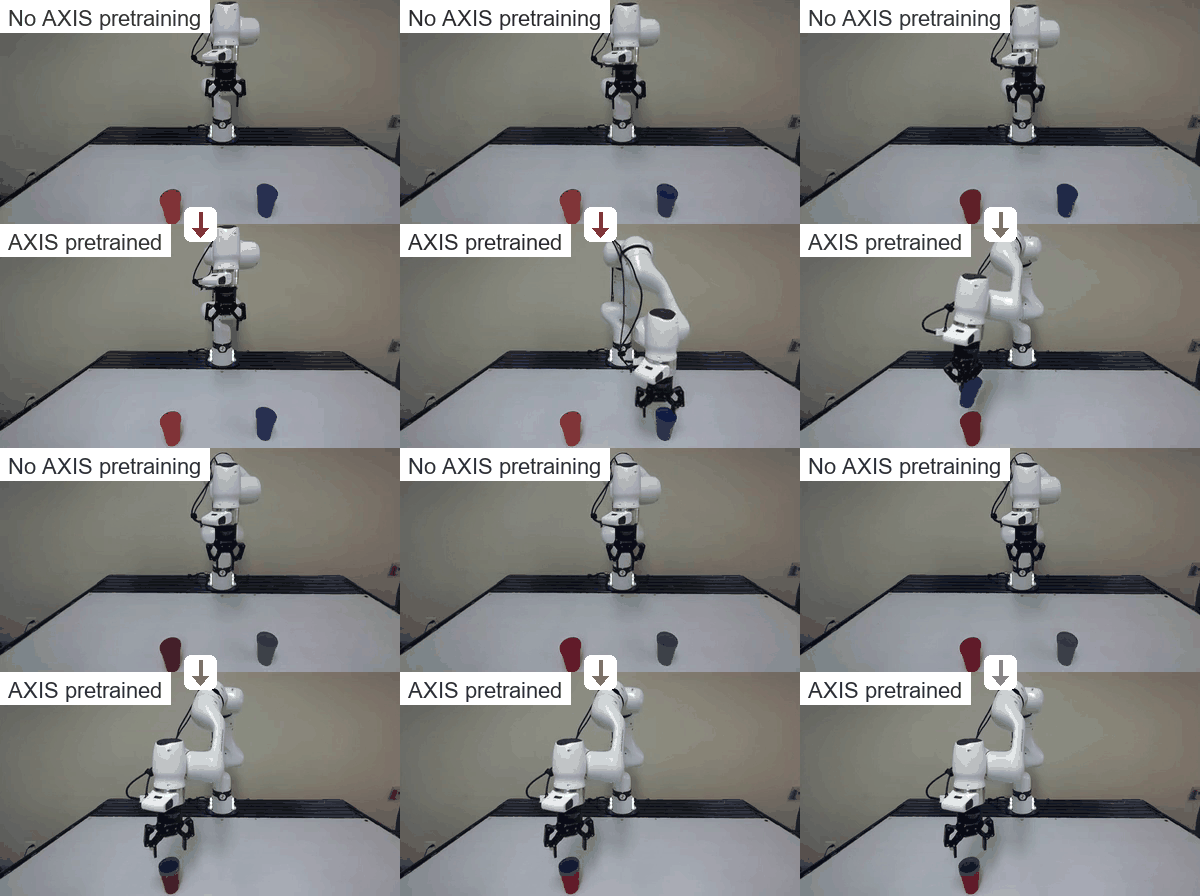 Place blue cup in red cup (1/6)
Detailed results: AXIS-Bench AXIS: A Growable Community-Driven Data Engine for Scalable Robot Manipulation
IROS 2026 Workshop on Physical World Models for Scaling Embodied AI
* Equal contribution.
A browser-based data engine turns community demonstrations into scalable robot training data.
Contributors collect simulated robot demonstrations directly in a web browser. AXIS generates and validates tasks, refines trajectories, and augments scenes to grow the dataset over time. Pretraining on AXIS improves policy robustness on LIBERO-Plus.
-
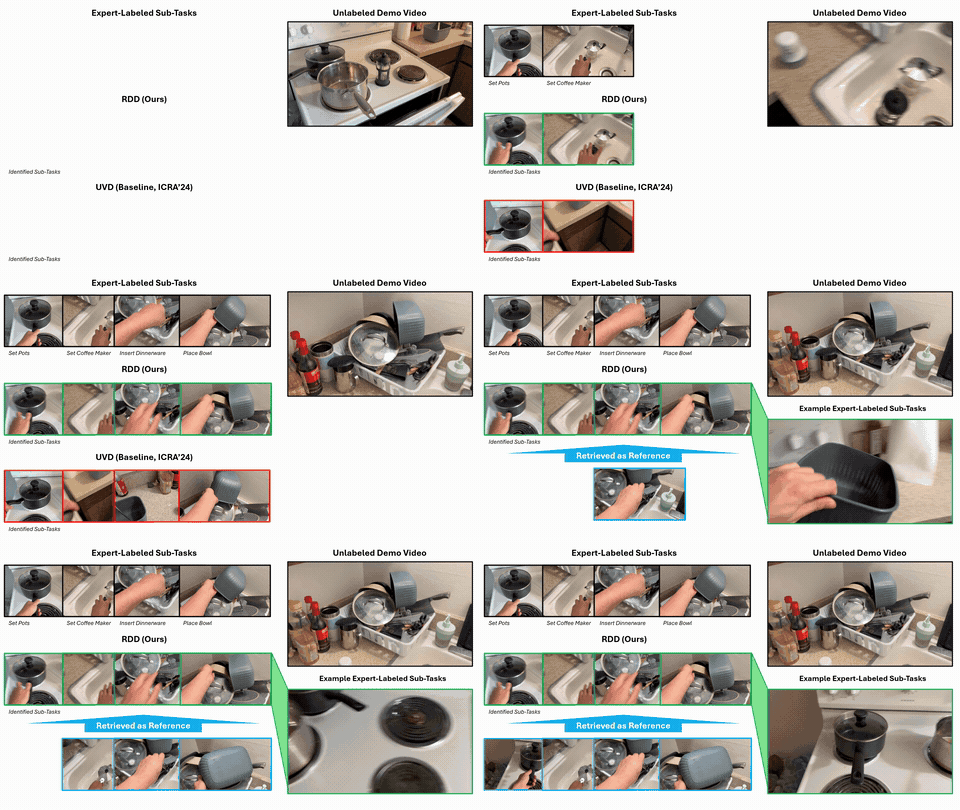
RDD: Retrieval-Based Demonstration Decomposer for Planner Alignment in Long-Horizon Tasks
NeurIPS 2025
Aligning planner supervision with robot skills improves long-horizon manipulation.
RDD decomposes long demonstrations by retrieving visually similar sub-tasks from the low-level policy’s training data. These segments provide aligned supervision for the high-level planner, bringing downstream task success close to that obtained with expert segmentation.
-
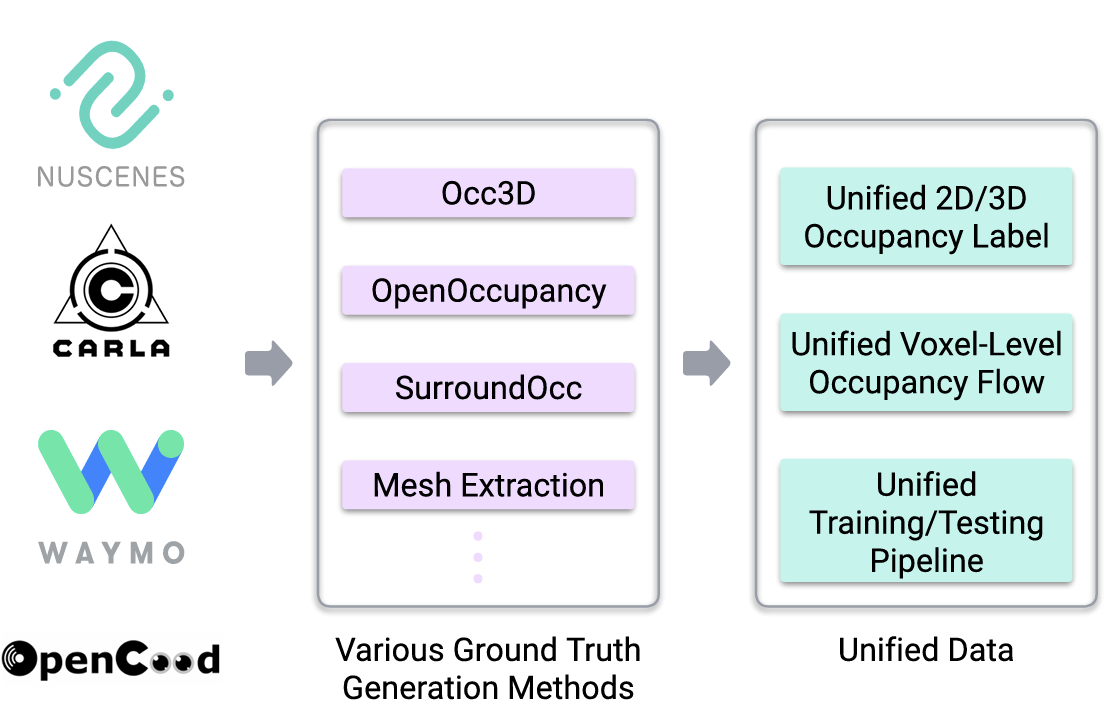
UniOcc: A Unified Benchmark for Occupancy Forecasting and Prediction in Autonomous Driving
ICCV 2025
* Equal contribution.
Unified occupancy data connects perception, forecasting, and cooperative driving.
UniOcc brings real and simulated driving datasets into a common format with occupancy and voxel-level motion labels. Shared evaluation covers current and future occupancy, including shape plausibility and temporal consistency without requiring ground-truth occupancy.
-
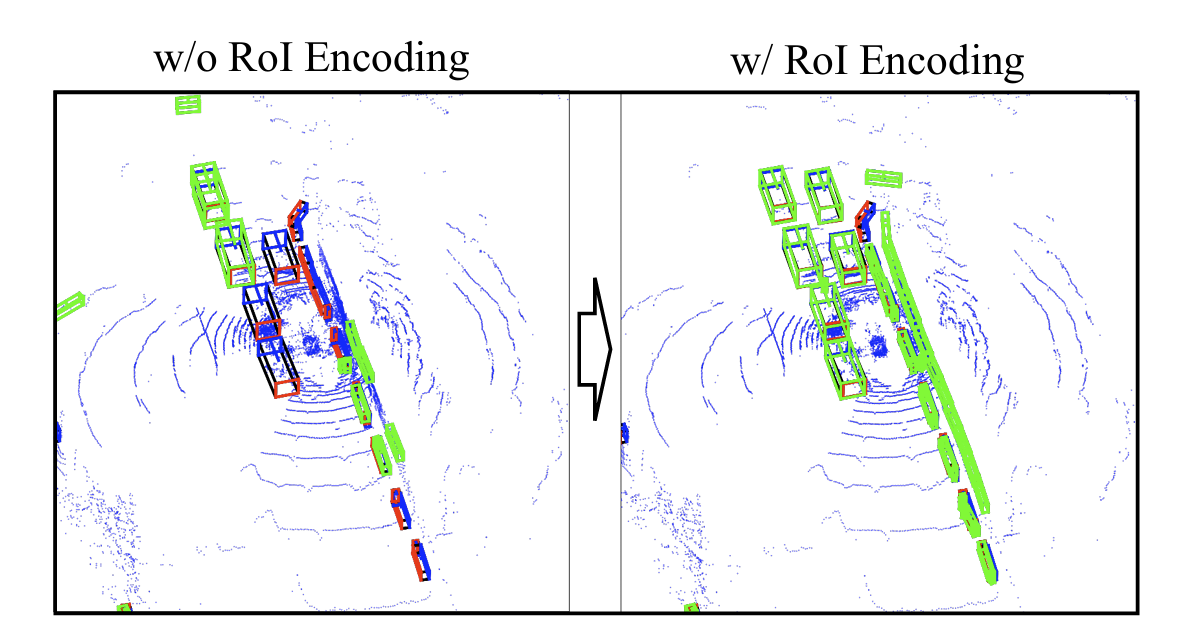
DetVPCC: RoI-based Point Cloud Sequence Compression for 3D Object Detection
arXiv preprint, 2025
Prioritizing object regions improves point-cloud compression for 3D detection.
DetVPCC uses a lightweight detector to identify regions likely to contain objects, then assigns them higher coding quality within VPCC. This preserves detection-relevant geometry and improves the bitrate-accuracy trade-off on nuScenes.
-
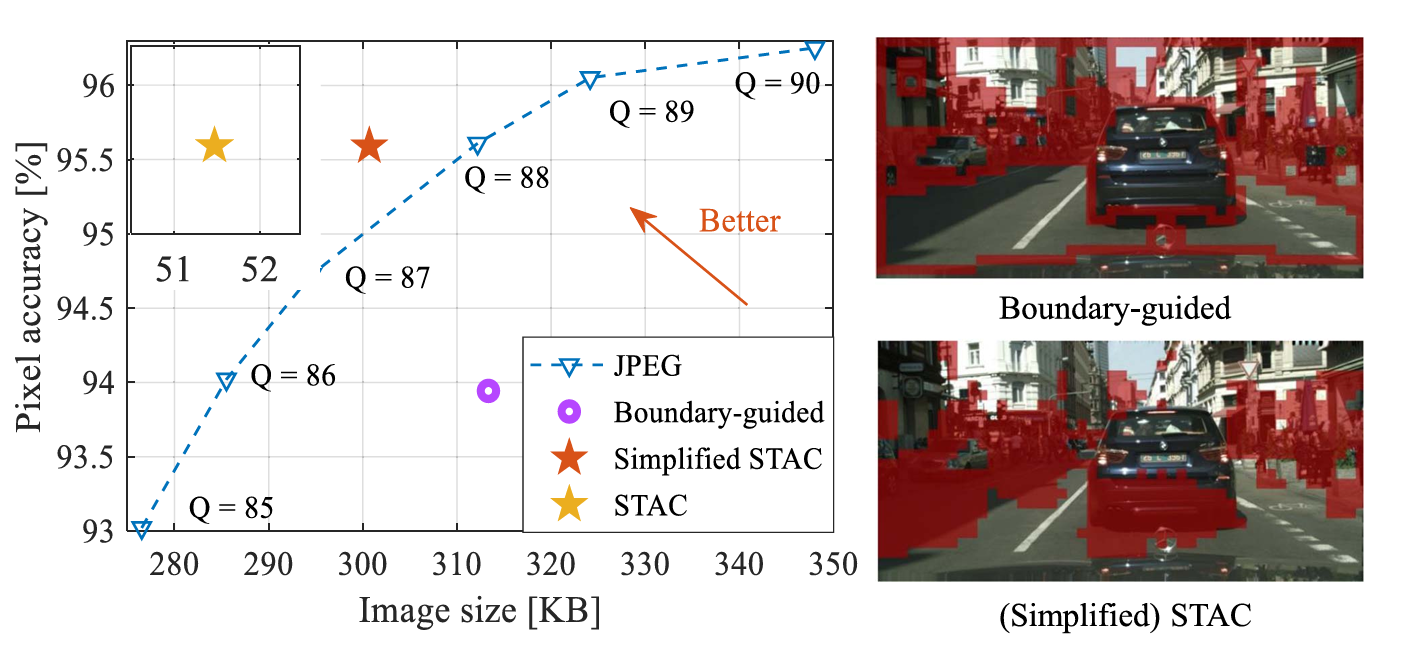
Task-Oriented Video Compressive Streaming for Real-time Semantic Segmentation
IEEE Transactions on Mobile Computing, 2024
Model-guided video compression preserves the details needed for semantic segmentation.
STAC uses network gradients to identify regions where compression most affects segmentation accuracy. It combines spatial and temporal compression with a learned bandwidth-aware controller, reducing transmission cost while adapting to changing video content and network conditions.
-
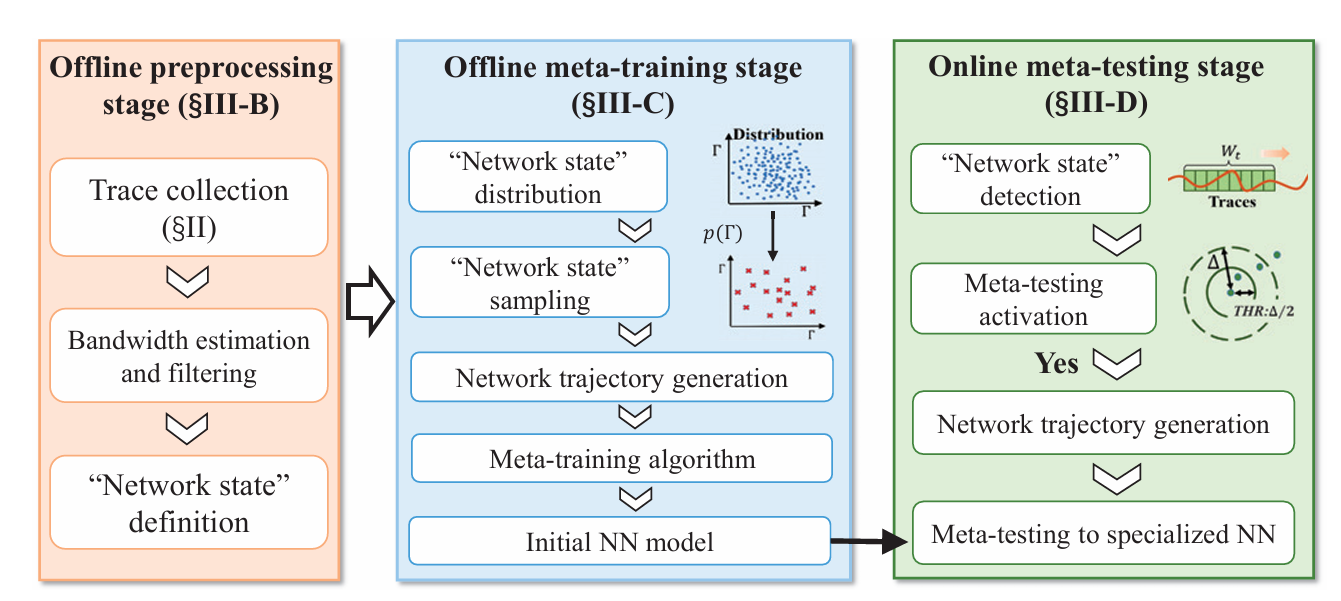
From Ember to Blaze: Swift Interactive Video Adaptation via Meta-Reinforcement Learning
IEEE INFOCOM 2023
* Equal contribution.
Meta-learning enables rapid bitrate adaptation as network conditions change.
Fiammetta learns an adaptable streaming policy offline and updates it online with a few gradient steps. Evaluated on real-world WeChat for Business network traces, it increases video bitrate without increasing the stalling rate.